
Trying to conceive, one cycle at a time
Preparing for pregnancy starts before you conceive. Regular ovulation, steady blood sugar and enough folic acid all play a part. For women with PMOS, insulin resistance can disrupt ovulation, which is why managing it matters when you're trying. No two women's timelines are the same, so plan the details with your doctor.
See follicare · from RM198How does PMOS affect fertility?
PMOS (formerly PCOS) is a hormonal condition that often goes hand in hand with insulin resistance, where the body's cells don't respond well to insulin. Together, they can affect ovulation and the hormones that prepare your body for pregnancy.
Knowing what's happening behind the scenes is a good first step, and it helps you have clearer conversations with your doctor.
How does insulin resistance affect ovulation?
Your body makes two forms of inositol that help carry insulin's signal inside cells: myo-inositol (MI) and D-chiro-inositol (DCI). An enzyme turns MI into DCI, and insulin sets how fast it works.
With insulin resistance, your muscles, liver and fat respond poorly to insulin, so they make less DCI and run short of it. Women with PMOS (PCOS) also clear DCI into their urine faster: almost six times faster than women without it, in one study (Baillargeon et al., Diabetes Care, 2006). So the body as a whole is short of DCI, which may add to insulin resistance.
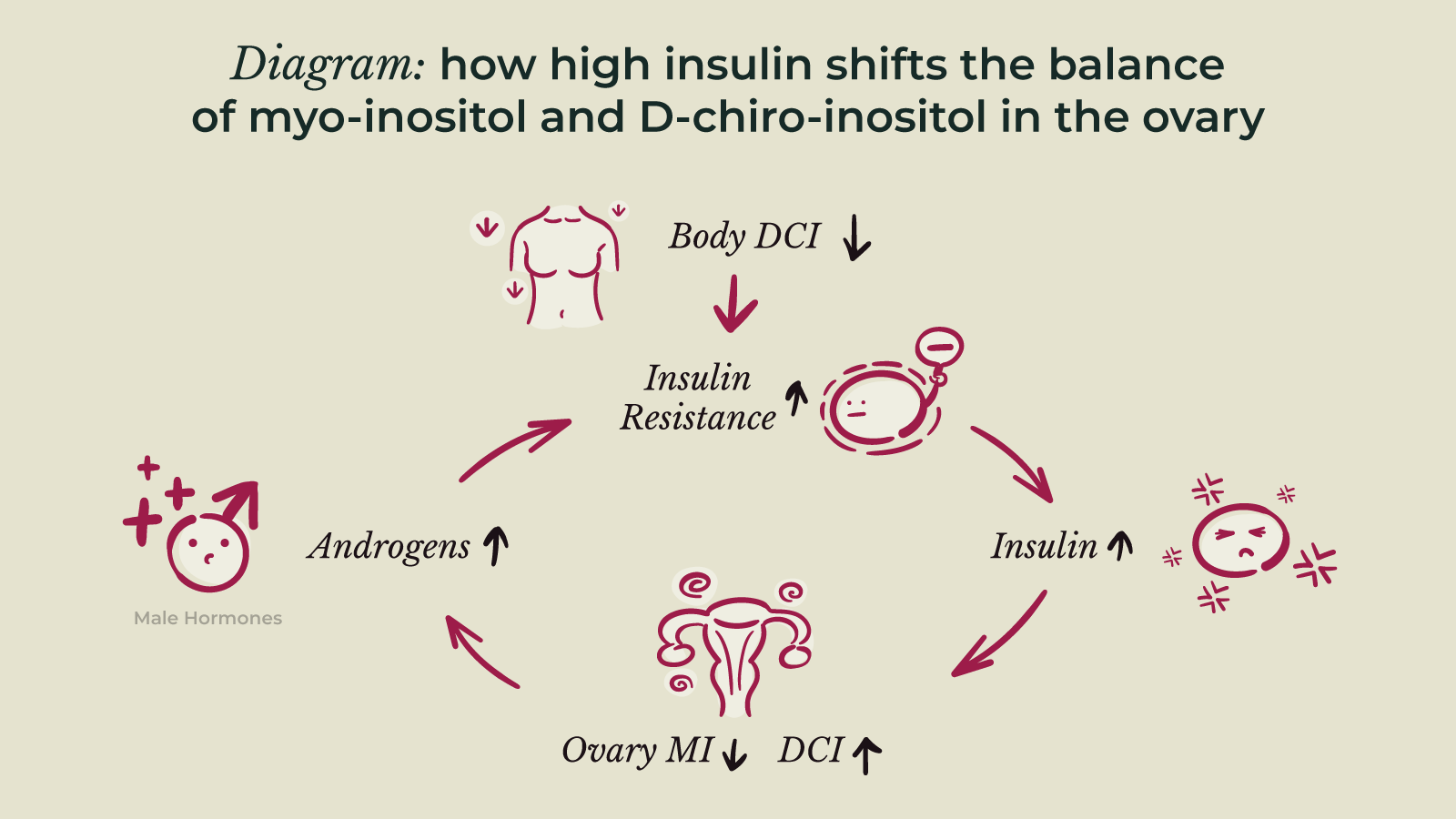
The ovary works differently. It stays sensitive to insulin, so the high insulin that comes with insulin resistance speeds up the enzyme there instead. Researchers call this the ovarian paradox: the rest of the body is short of DCI, while the ovary makes too much DCI and runs short of MI.
Too little MI in the ovary can blunt the action of follicle-stimulating hormone (FSH), which eggs need to mature. At the same time, extra DCI can push up androgens, often called male hormones. Together, these can affect egg quality and lead to irregular ovulation, or sometimes no ovulation at all.
Studies haven't shown that DCI made in the ovary travels back to the rest of the body.
Even if a little did, the ovary is small. It couldn't make up for low DCI in your muscles, liver and fat.
Low DCI in the body is linked to a weaker insulin response. To cope, the body makes more insulin. The ovary reacts to this extra insulin and produces more androgens. Higher androgens can weaken the insulin response further, so the cycle keeps going.
Getting the balance of MI and DCI right may help support the body's insulin response, where this cycle begins.
How does follicare support fertility?
follicare pairs myo-inositol and D-chiro-inositol in a 3.6:1 ratio: 300 mg of D-chiro-inositol in every sachet, alongside 1,100 mg of myo-inositol. In research, the 3.6:1 ratio was tested against a 40:1 formula with the same myo-inositol and 27.6 mg of D-chiro-inositol a day.
follicare assists with managing insulin resistance and supports ovulatory function, and each sachet carries 400 mcg of folic acid. It can't promise pregnancy, but it can be part of how you prepare.
Trying to conceive without PMOS?
follicare isn't only for women with PMOS. With myo-inositol, D-chiro-inositol, folic acid and inulin, it can be part of how any woman prepares for pregnancy.
The World Health Organization recommends that women trying to conceive take 400 mcg of folic acid a day, from when they start trying until 12 weeks of pregnancy.
Having IVF or IUI?
Talk to your fertility doctor before adding any supplement during treatment. follicare is meant to sit alongside your medical care, not replace it.